Menu
Other locations

The Green Turtle – If you’re a scuba diver looking for one of the most peaceful and rewarding encounters in the ocean, few experiences rival hanging out with a Green Turtle. Green Turtles have to be one of the most chilled out creatures in our oceans who are happy to spend their days chomping on the reef, sleeping or just lazily swimming around. However don’t let their chilled demenour fool you! These beautiful animals have been gracing this planet for a long time. Read on to find out more!
What is a Green Turtle?
Green Turtles or Chelonia Mydas are named after the colour of their fat! They get this colour from their herbivore diet. They are most commonly found in shallow, well vegated coastal waters and close to islands in the Atlantic & Indo-Pacific oceans, including the Gulf of Mexico & the Mediterranean sea.
Green Turtles along with their closest relative the Black Turtle are the only herbivorous sea turtle.
Their average length is about 1 metre & weight 150 kg. The biggest Green Turtle ever found was 1.52 metres long and weight a whopping 395 kg!!
Basic Anatomy
Key Anatomical Features:
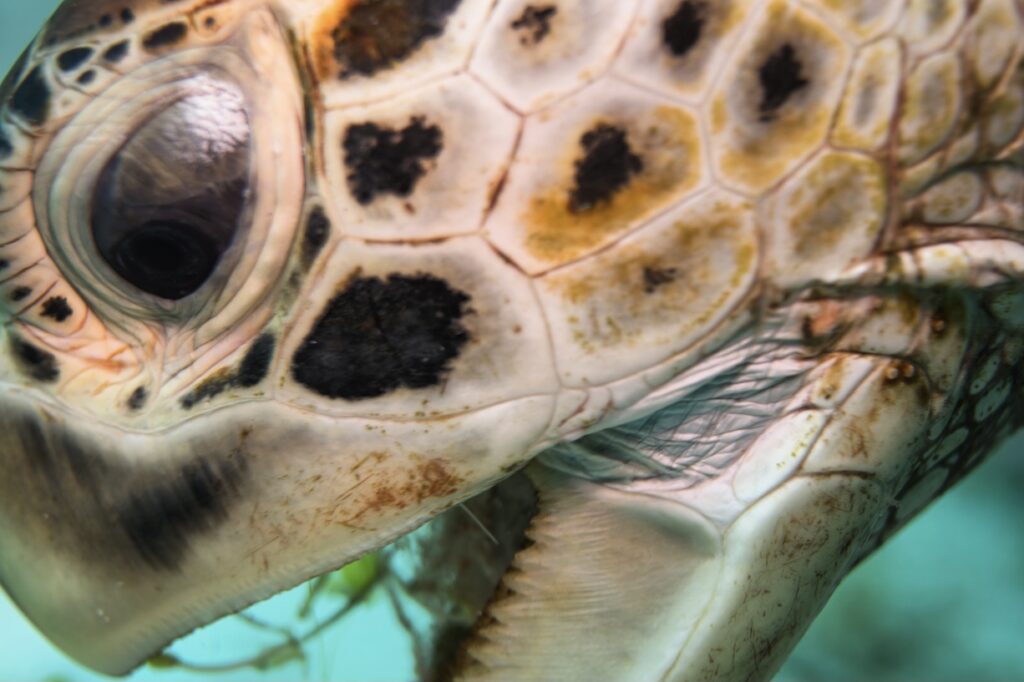
Green Turtles (like all turtles) have great underwater vision, but are near sighted above the water.
Turtle Tears – you may have heard people talk about turtles crying. This is partly true as turtles do use ‘tears’ to help release excess salt and fluids to keep the eyes moist and help rid salt from their bodies which they ingest while drinking.
Diet:
Green Turtles can often be seen chasing jellyfish or grazing on seagrass beds.
Lifespan & Maturity:
Behaviour & Ecology:
Green Turtles only go on land to lay their eggs and are known to travel thousands of kilometres to reach their hatching destination. They dig their nests in the sand and typically lay about 100+ eggs. They can nest a few times in one season.
Apart from going on land to lay their eggs Green Turtles spend all of their lives in the ocean. Green Turtles are “keystone” herbivores on seagrass meadows – by grazing on sea grass beds they help to keep the environment healthy. Like with other keystone creatures Green Turtle numbers are an indicator of overall coastal and marine ecosystem health.
Global Numbers & Conservation Status
The Green Turtle is one of the most widely distributed sea turtles, inhabiting tropical and subtropical waters. Nesting occurs in over 80 countries and they live in the coastal areas of over a 140 countries.
While precise global numbers are hard to say population numbers reman under threat and experts are in agreement that populations are declining with egg poaching, by-catch, loss of habitats and interruptions to nesting behaviour being the biggest factors.
Diving with Green Turtles — Practical Tips
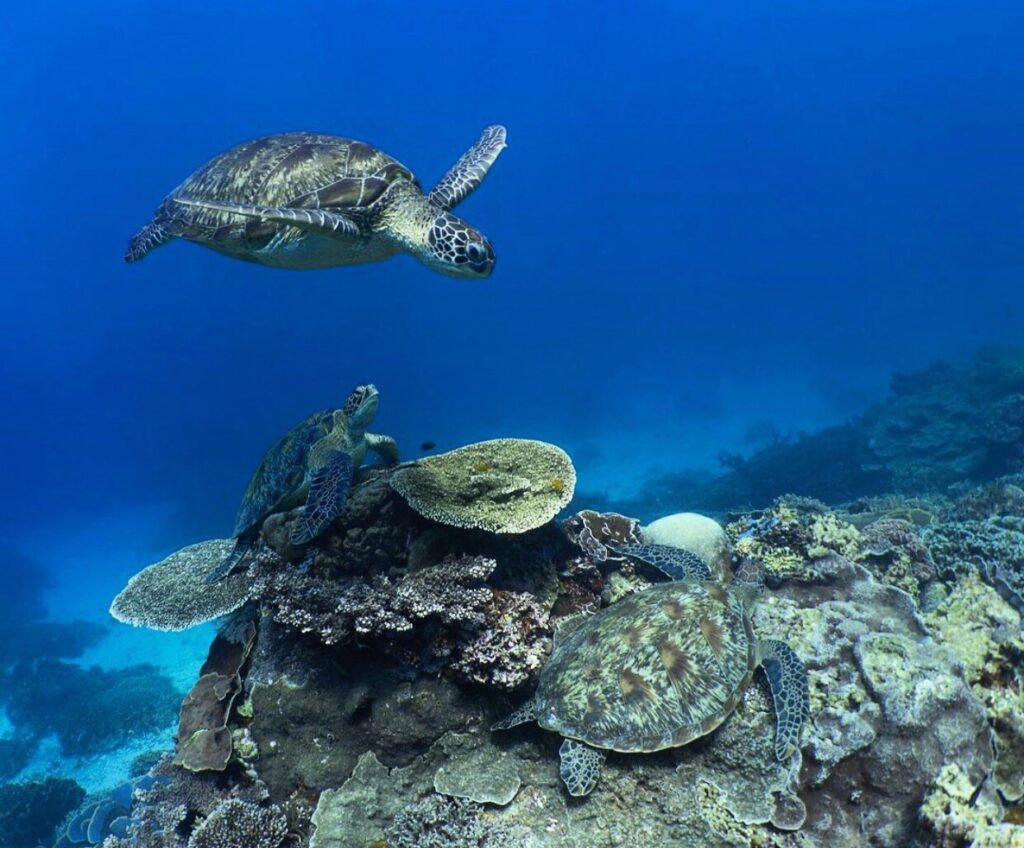
Green Turtles can often be found feeding in seagrass beds, resting on coral bommies or cruising above the reef. They are typically relaxed and peaceful with many individuals not being bothered by the proximity of divers. However it remains important as divers to remember that we are the guests underwater and we need to be respectful of the creatures around us at all times.
We must ensure best practice in how we act. We need to move slowly, approach from the side so the turtles can see us and not be startled. We need to not get over excited and get too close or move to quickly. We must try not to reach out or get a reaction. We must try not to interrupt their behaviour and let them be in control.
Good bouyancy and avoiding touching the seabed or coral is vital. Not only can this cause damage to corals vegetation and other marine life but it can stir up sediment, scare the turtles and ultimately run the experience.
We have a strict “no touch” rule. Touching and chasing of turtles should be discouraged. It is not only intrusive for the turtles, but can cause distress and injury and result in altered behaviour.
Its important to never attempt to block a turtle moving to the surface. They are doing this to take a breath and as divers we need to be mindful of this.
If you ever come across a Green Turtle on a beach – they are nesting! They are finding a safe place to lay their eggs that will give their little ones the best chance of survival. Please do not block paths from or to the ocean. Don’t approach the mother or try to uncover the eggs.
Turtle ID – Green or Hawksbill
One of the commonest questions we get asked by our guests is how to tell the difference between a Green and a Hawksbill Turtle.
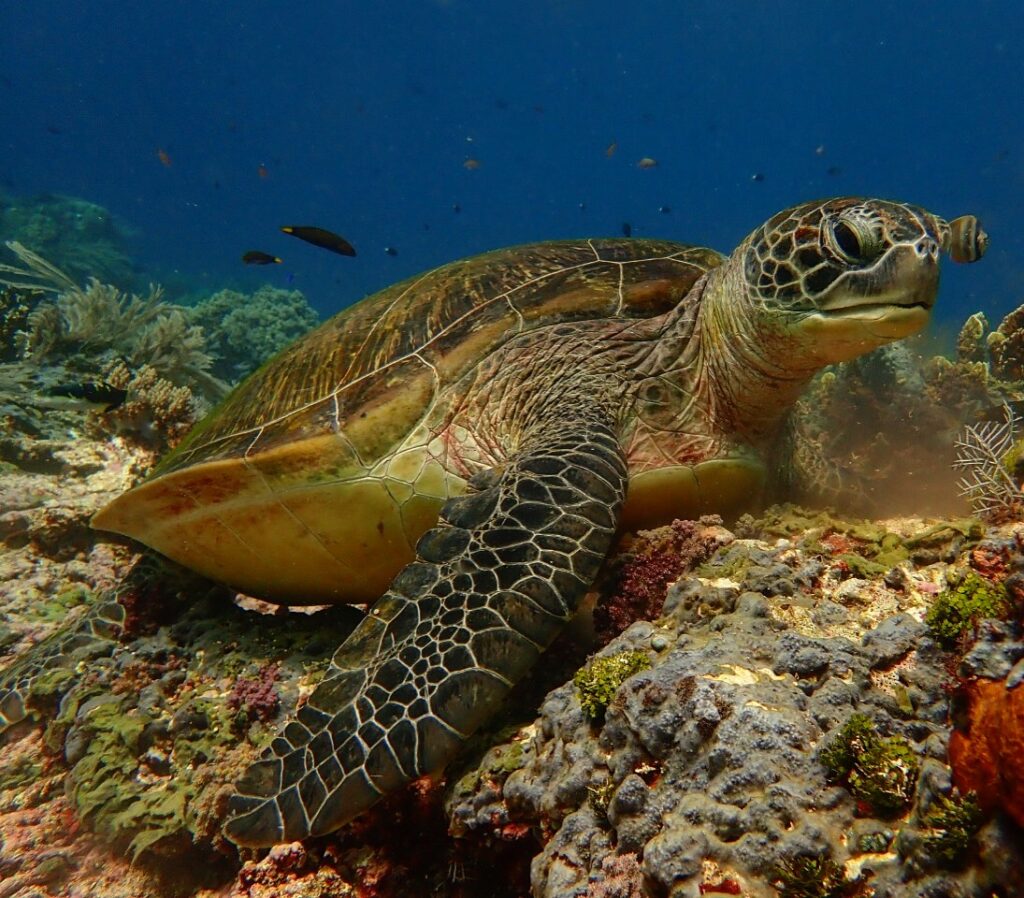
The most obivous feature is the shape of the head / beak. The Green Turtle has a more rounded, blunted beak with a serrated jaw line. Hawksbilll Turtles have a more pointed, hawk-like beak.
The Green Turtle has 2 large scales between the eyes whereas the Hawksbill has 4.
Photo 1 below is a Green Turtle.
Photo 2 is a Hawksbill Turtle.
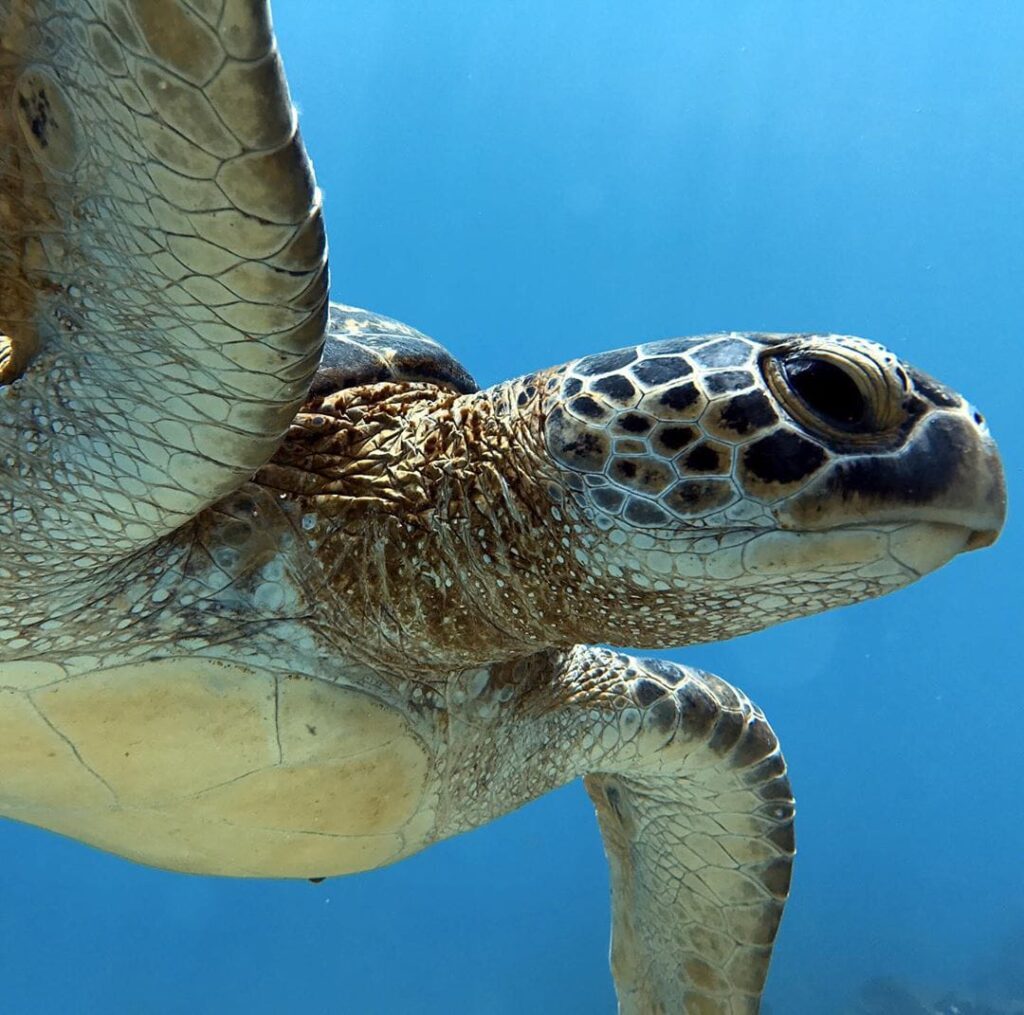
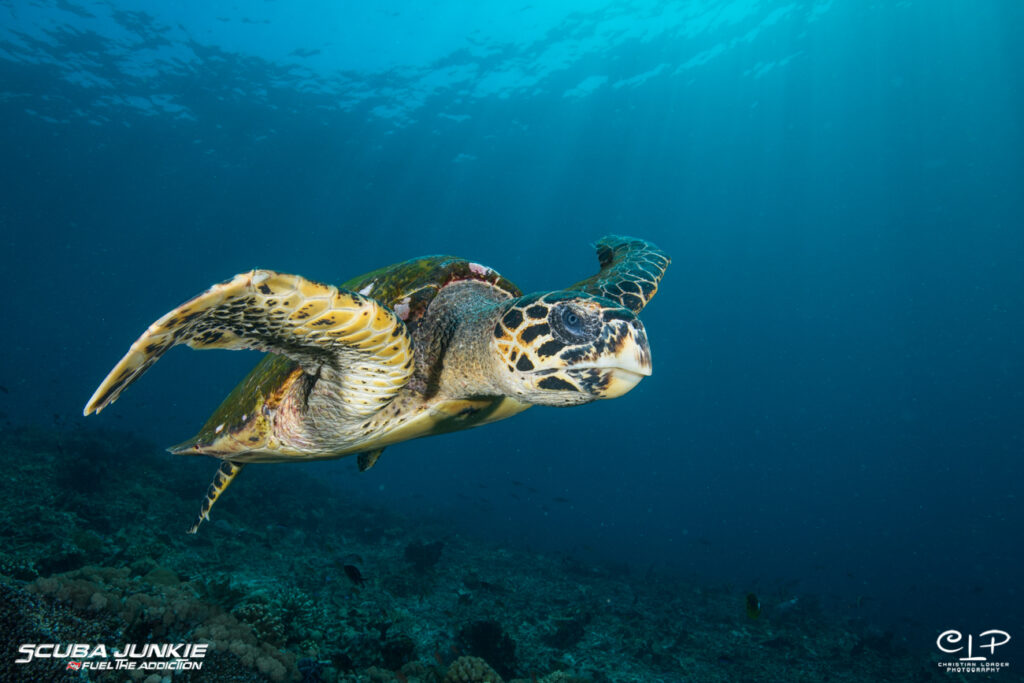
The other main differences are the shape of the carapace. The Green Turtle is more rounded (like it’s face) with smooth scutes that don’t overlap. The Hawksbill shell is more jagged with overlapping scutes. Hawksbill also tend to be smaller and have 2 claws on their front flippers while the Green Turtle is larger with just 1 claw on each flipper.
Always remember to ask your dive guide if you need help to ID what you have seen!
It is also possible to help with the IDs / population counts of sea turtles. We talk a lot abour ID shots for mantas here, but the same can be done for turtles! We just need clear images of the side of their faces. Check out the Internet of Turtles for more information on where you can upload your photos, what is needed and how you can track where your turtle has been seen before!
Spotlight on Indonesia & Komodo National Park
The dive sites around Komodo National Park offer consistent Green Turtle sightings with dive sites such as Siaba Besar (nicknamed Turtle Town!) being particularly exciting! We have been lucky enough to see upwards of 30+ Green Turtles on one dive here!
This sheltered horse shoe shaped bay offers calm water, shallow coral gardens, plenty of coral bommies and sea grass to munch on.
Green Turtles are considered to be the most commonly seen turtle in this region. It is possible to see Green Turtles all year around here and on many dive sites not just Siaba Besar.
In places like Komodo, the chance to dive in one of the world’s richest marine biodiversity hotspots and swim alongside these turtles adds a magical layer to the underwater experience. But with that privilege comes responsibility: as divers we must be ambassadors for them — observing, respecting, and helping sustain their habitats.
So next time you gear up: keep an eye out for that smooth‐oval shell, the rounded face, the gentle chomping of the seagrass, the turtle quietly resting on a coral bommie……..
If you would like to find out more about Turtles check out Our blog – The Seven Species of Sea Turtles.