Whether you’re just starting out or have a quite a few dives under your belt, mastering buoyancy is one of the most valuable skills you can develop as a scuba diver. Not only does good control make diving more enjoyable, it also helps protect the marine environment, conserve air, and reduce fatigue underwater.
Have you ever envied your dive guide underwater?! Watched them glide along effortlessly, hold position while staring at the reef, looking like they are doing minimum effort while you follow along behind.
“How do I improve my buoyancy?” is a very commonly asked question so we thought we would share some tips. In this post, we’ll break down what buoyancy is, why it is so important for every diver to focus on and how to improve your skills to help you become a better diver.
What Is Buoyancy in Scuba Diving?
This is the force that allows you to float, sink, or hover underwater. In the simplest terms it is the balance between your weight and the amount of water you displace.
There are three types of buoyancy:
Positive – You float up.
Negative – You sink down.
Neutral – You don’t move up or down meaning you can hover effortlessly at a particular depth and maintain this.
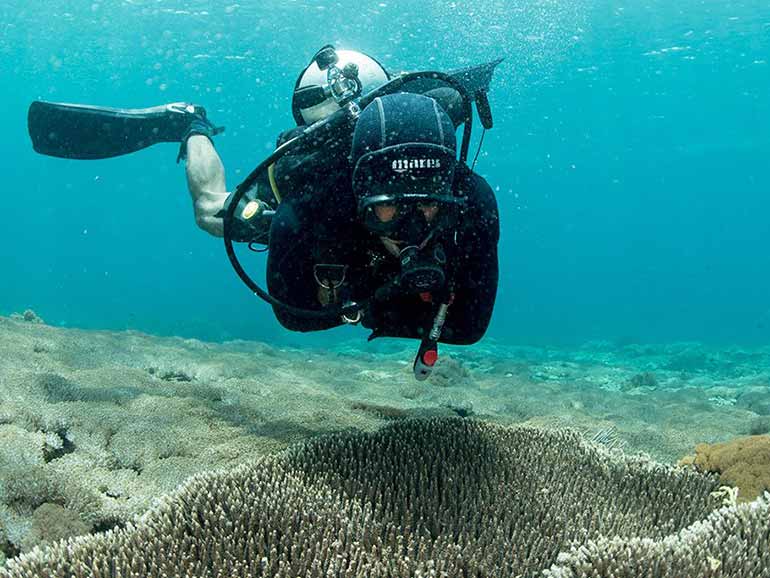
Achieving neutral buoyancy means you’re not fighting gravity or the surface – you’re simply suspended in water, gliding with ease and requiring minimum effort to hold your position.
Why It Matters
Air Consumption: Struggling with your positiong means you’ll be wasting energy trying to hover effortlessly in the water. This means you move more, breathe faster and use your BCD more. This can result in a shorter dive time.
Marine Protection: It is very important that we have a ‘no-touch’ policy while underwater. Even the lightest touch, accidental or not, can disturb, damage or even kill marine life. Poor control can lead to accidental contact with marine life.
Safety: Overweighting or underweighting can make ascents and descents more dangerous as you end up “fighting” your weight rather than being in full control. It will also affect your positioning, your trim and your effort which results in faster air consumption.
Enjoyment: Neutral buoyancy makes you feel weightless – one of the absolute best parts of diving!!
Tips to Improve Control
1. Fine-Tune Your Weighting
Many divers are over-weighted, especially beginners. Start by doing a buoyancy check at the surface with an empty BCD and half-full tank. You should float at eye level while holding a normal breath. When you exhale, you should slowly sink. You are taught this on your Open Water Course, but many people forget to do it after this!
✔️ Tip: Use your logbook to record how much weight you used in different environments and different set-ups. For example freshwater or salt water, a 5mm long wetsuit or shorts and a rashy and so on!
2. Practice Proper Breathing
Your lungs are a natural buoyancy control device. With each breath your body will move. A deep breath makes you rise slightly; a long exhale helps you descend. It is important to remember that the reaction of your position will be delayed so when you breathe in it will take a second before you start to raise up and the same when you exhale it will take a second for your position to lower again.
✔️ Tip: Try “breathing” – practice hovering just by adjusting your breath. Be patient. Learn the timing and be able to know how long the delay is between your breathing and your positioning.
3. Master Your Trim
Trim refers to how your body is positioned underwater. Ideally, you want to be horizontal, like a torpedo. This makes you more streamlined and in control. Make sure your fins are up behind you and not dropping below. Bend your knees. Cross or hold your arms. Look ahead! Make sure your gear is stowed so nothing is dangling below you.
✔️ Tip: Make sure your BCD is securely fitted and that your weight-belt (if using the traditional belt is tight to your body). Adjust your weights so they are equal around your body. Try them in different places – at the back – the sides – the front. Figure out what works for you.
4. Use Your BCD Sparingly
Your BCD isn’t a lift bag – it’s there to make small adjustments. Avoid inflating/deflating too much. Use short, controlled bursts of air. Remember the delay. Be patient. Note the change in your position. Add or release more if needed. If you watch your guides they rarely use their BCD after the initial descent under the surface. Experienced divers will rely solely on their breathing to maintain neutral buoyancy and will avoid using their BCD. Fine tuning your buoyancy will stem from your improved breath control and using your BCD less!
✔️ Tip: Make adjustments slowly and wait a few seconds to feel the change.
5. Take a PPB Course
PADI’s Peak Performance Buoyancy (PPB) course is a game-changer. You’ll get real-time feedback on your technique and have a chance to practice in a controlled environment. Here we encourage all of our Advanced Open Water Course students to start out with PPB. We also offer the PPB Speciality Course. This is a great course that will really help you improve your skill underwater. It is also a lot of fun!!
6. Dive, Dive, Dive
There’s no substitute for experience. The more you dive, the better your body awareness and buoyancy control will become. For many the change is noticeable over time, but for sure the more attention you can pay in the beginning while you are diving the more quickly you will see improvements!
✔️ Tip: On every dive, practice your breathing, focus on your position, be aware of where you are, try to be still. All of these things can be done while you are enjoying your dive!!
Common Mistakes to Avoid
Adding too much weight “just in case”
Filling the BCD too fast or too often
Holding your breathRemember the Golden Rule of scuba diving – NEVER EVER hold your breathe. Always breathe continuously!
Final Thoughts
Buoyancy isn’t something you master overnight, but every dive is an opportunity to improve. With some patience, awareness, and practice, you’ll find yourself gliding through the water like a pro — conserving air, protecting reefs, and enjoying the true freedom of diving.
One comment on “Mastering Buoyancy: The Key to Effortless Scuba Diving”
Nice post! 1754725450
about us
We provide daily dive trips and dive courses around the Komodo National Park.
Looking for tips and tricks about diving, marine life or what to do in Indonesia? Follow us on our blog for weekly updates from the team!


Nice post! 1754725450