Reef sharks are among the most charismatic denizens of coral reefs. For many divers, seeing them can be the absolute highlight of any dive, but there is also much to think about in terms of their important roles in the underwater eco-system and the threats to their population.
In this blog we will delve a little deeper into what we know about the 3 most common species of reef sharks in Komodo National Park.
What are Reef Sharks
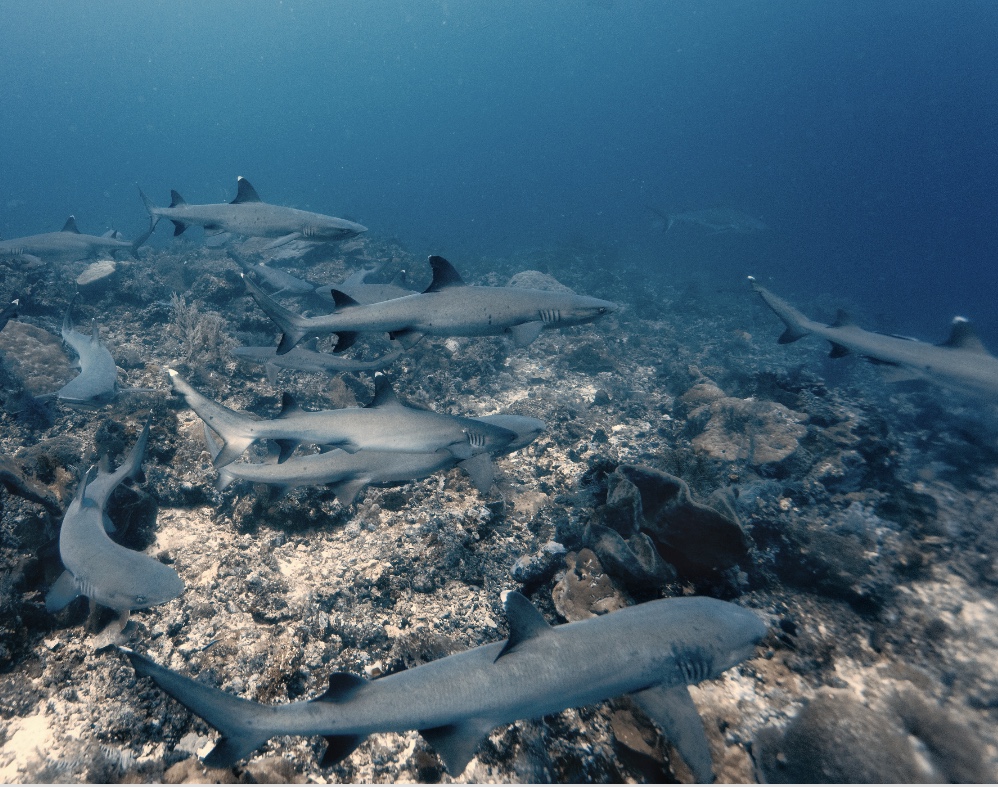
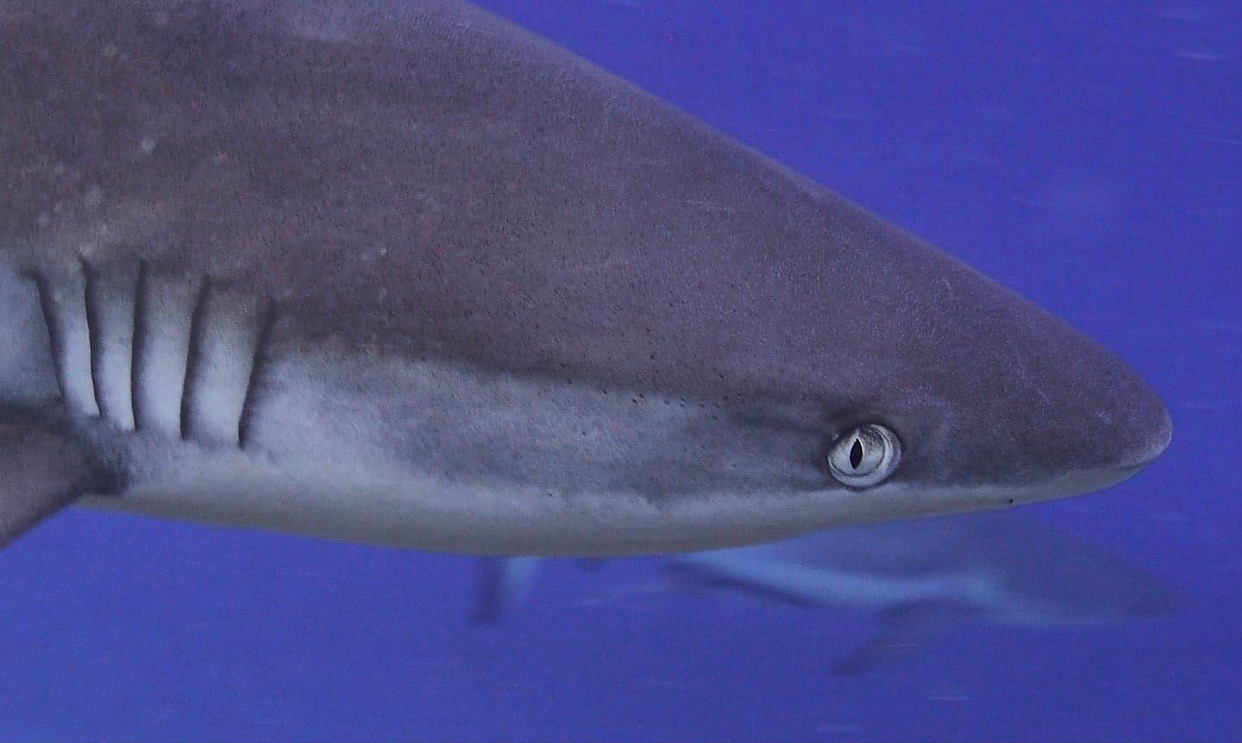
Reef sharks are carnivorous Requiem Sharks that live in tropical and subtropical waters – usually close to coral reef systems. The 3 most common types of sharks we see in Komodo are Whitetip, Blacktip & Grey Reef Sharks.
How to ID Reef Sharks
When you’re 20 meters underwater, the current is flowing & your excitement is running high, it’s not always easy to ID a shark cruising past, but was you understand the basic ID markers of each individual type of shark it does become a lot easier!
Here’s how to tell them apart at a glance:
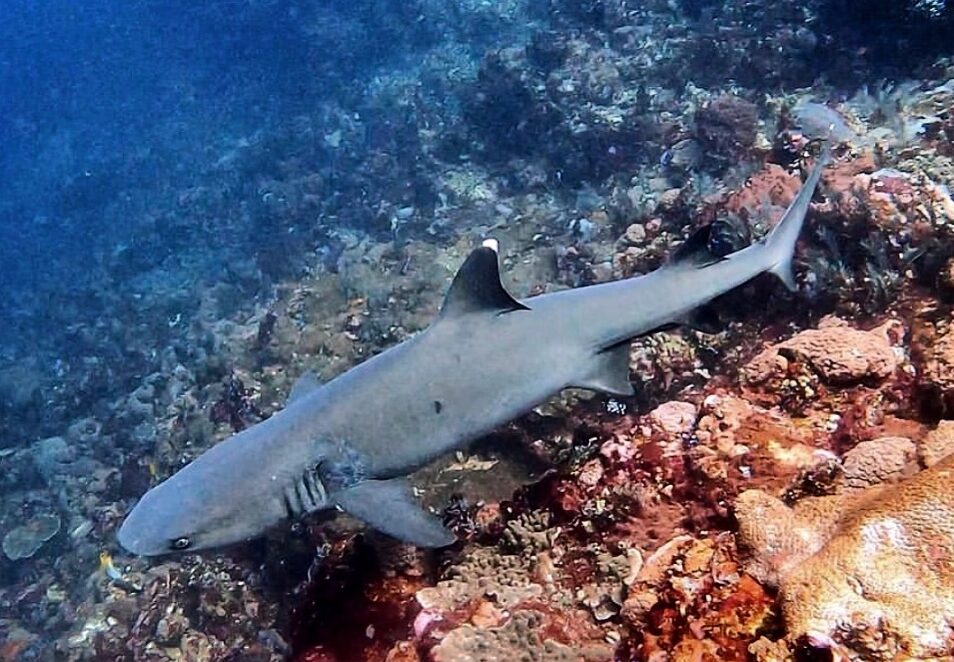
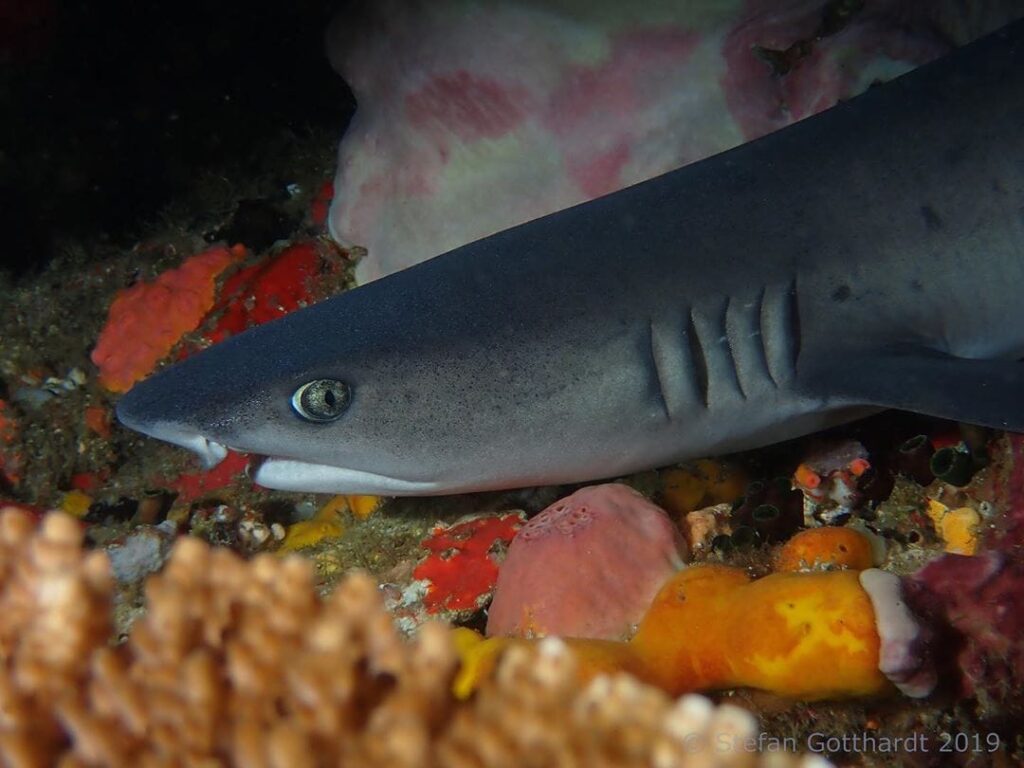
1. Whitetip Reef Shark
(Triaenodon obesus)
Key ID Features:
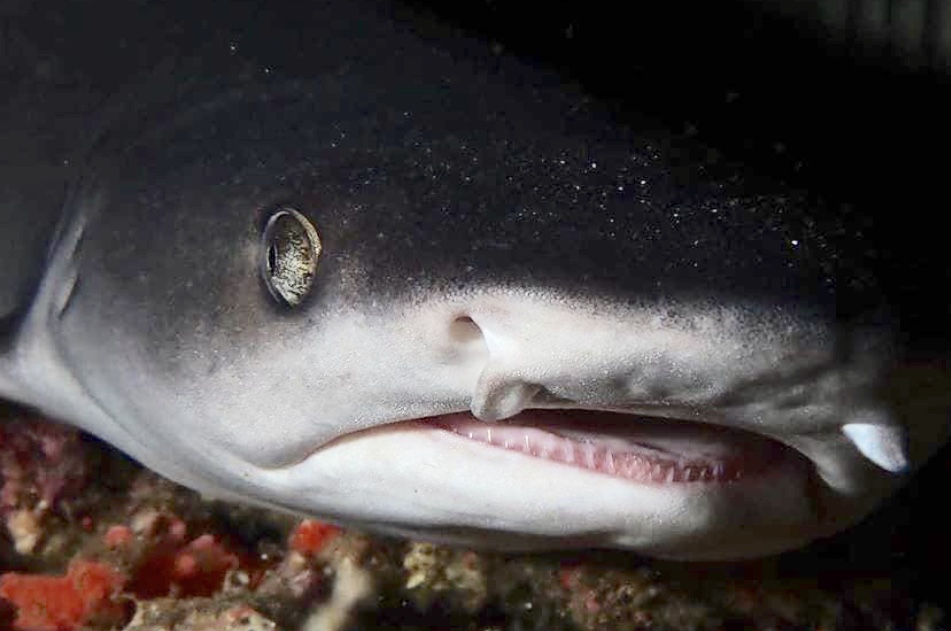
Most obvious: white tips on the first dorsal fin and upper caudal fin (tail).
Slender body, but more stocky-headed than Blacktips; has a blunt, flattened snout. Our dive guides often call these sharks the “puppy dogs” of sharks!
Eyes appear slightly more “sunken”; distinct ridges above the eyes.
Uniform light grey to brownish grey.
Size: Can grow to around 1.6 meters. In Komodo the common size tends to be around 1.2 meters.
Behaviour: Often can be seen “resting on the floor” Unlike other Requiem Sharks Whitetips use a method of breathing called buccal pumping which means the motion is caused by their jaw muscles to move the water over their gills. If you get close enough to a resting Whitetip you can see the jaw gently opening and closing or just moving slowly. Other Requiem Sharks rely on “ram ventilation” which means they must keep swimming to force the water through their gills.
Can often be found in the open, but tend to prefer to hide under table corals, rocky crevices, small caves if they can as this offers them protection while they rest. Especially the smaller pups!
Less mobile than some sharks. Small home ranges. Usually more active at night. Not aggressive towards humans. Very chilled sharks!
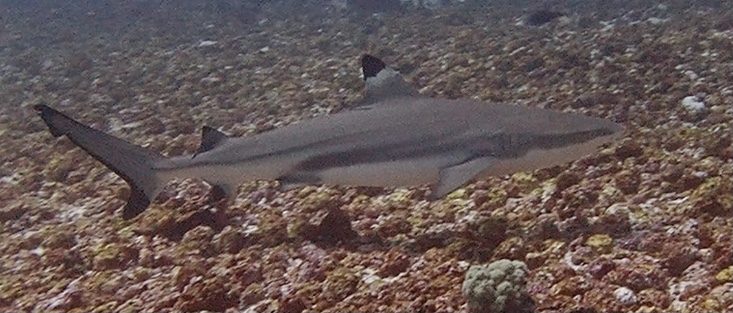
2. Blacktip Reef Shark
(Carcharhinus melanopterus)
Key ID Features:
Distinct black tips on most fins — especially the dorsal fin and tail fin (caudal).
Streamlined shape with a short, more pointed snout and large eyes.
Lighter body, usually pale grey or tan above, white underneath.
Has a dark vertical bar behind each gill slit (seen clearly from the side).
Size: Usually up to 1.6 meters.
Behaviour: They tend to be active swimmers, a little shy but may come in close to check out divers if they’re calm and still. You’ll often see them cruising in 2–5 meters of water at sandy reef edges or coral bommies. Juveniles are often seen in shallow areas or hiding under coral.
Often near shallow reefs and lagoons. Usually solitary or small groups. Usually stay within the same home range. Blacktips are more active, sometimes quite curious to divers so they will come closer to check you out!
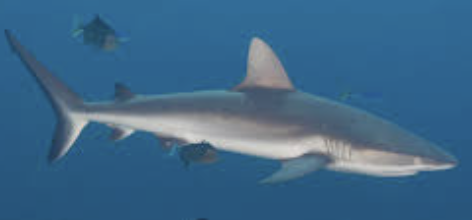
3. Grey Reef Shark
(Carcharhinus amblyrhynchos)
Key ID Features:
Has a white trailing edge on the pectoral fins and a slight white tip on the tail fin (but not the same sharp contrast as Blacktip or Whitetip).
Often has a distinct black edge on the tail fin (lower caudal lobe).
Dorsal fin is tall and curved, no prominent markings.
Uniform grey body with a white underside — darker than the other two species.
Body is more muscular, torpedo-shaped — a fast, strong swimmer.
Size: Larger — up to 1.9 meters. Often seen in the 1.2–1.6 m range.
Behaviour: Often found patrolling reef edges or drop-offs. Moves in wide, slow circles or straight lines. Occasionally displays territorial behavior, especially if approached too closely.
More likely to see them in stronger currents and at deeper sites.
Often seen in groups (especially daytime), frequent drop‑offs, reef slopes. At night disperse more broadly to forage. Active sharks, with a larger home range. Can be territorial while hunting.
Quick ID Summary Table
Feature
Whitetip Reef
Blacktip Reef
Grey Reef
Fin Markings
White tips on dorsal & tail only
Black tips on dorsal, tail, pectoral
No strong fin tips, slight white edge on tail
Body Color
Grey to brownish grey
Light grey, black bars near gills
Uniform dark grey
Snout Shape
Broad, flattened
Short, rounded
Pointed, angular
Size (Max)
~1.6 m
~1.6 m
Up to ~1.9 m
Day Behaviour
Can be resting or active
Active – often in shallow water
Cruising mid-water or reef edge
Seen At
Shallows, coral bommies
Shallows, coral bommies
Drop-offs, deeper walls
Tips for better IDs
Approach calmly and neutrally buoyant — sudden movement scares most reef sharks off.
Let them come to you: Like we say with mantas let them come to you and control the interaction. They will often get much closer when you are calm and still.
Look under ledges and coral: Whitetips love to rest during the day — they may be tucked in tight spots.
Be shark-aware at current-heavy sites: Grey Reefs prefer active water where prey is pushed through channels and slopes making for great hunting!
Reef sharks like Whitetip, Blacktip, and Grey Reef Sharks combine graceful beauty with ecological importance. They have slow life histories: late maturity, low numbers of pups, long gestation periods—which makes them vulnerable.
Trait
Whitetip Reef Shark (Triaenodon obesus)
Blacktip Reef Shark (Carcharhinus melanopterus)
Grey Reef Shark (Carcharhinus. amblyrhynchos)
Diet
Prefer small bottom dwelling prey. Fish, cephalopods, crustaceans. Hunt more actively at night/slack tide. Rest during day under overhangs.
Fish, cephalopods, crustaceans. Sometimes drive schools of fish (e.g. mullet) toward shore.
Fish and reef organisms. Generalist reef predator, often around drop‑offs and reef walls.
Reproduction (Gestation, Litter, Maturity)
Gestation ~10‑13 months. Litters of 1‑6 pups (often 2‑3). Sexual maturity reached around 8‑9 years, depending on region.
Viviparous (yolk‑sac placenta). Gestation varies with region: 7‑9 months (e.g. northern Australia), often ~10‑11 months in other areas, up to ~16 months reported in some cases. Litter size 2‑4 (occasionally more). Males mature earlier (~4 years) than females (~7‑8).
Viviparous. Gestation ~12‑14 months. Litter 1‑6 pups every other year. Maturity later (≈7 years) in many populations.
Lifespan
Lifespan less well documented, but implied to be long relative to time to maturity.
Typically around 10‑15 years, perhaps longer in favorable conditions.
Slower life history. Mature later with fewer offspring making them more vulnerable to human threats. Lifespan again not very well documented.
Global Trends: Population Status & Threats
While precise global population numbers are hard to come by for these sharks, there are some strong indicators and studies that give a picture of their status and trends. Unfortunately the outlook for sharks does not look good. Sharks are victims of active fishing for human consumption and use in herbal medicine as well as the product of by catch with long line fishing and large trawler nets.
A recent study assessed five key reef shark species (grey reef, blacktip reef, whitetip reef, nurse, and Caribbean reef sharks) across many reefs globally. It found that these reef shark populations have declined by ~60‑73% over the past decades.
Also, about 20% of surveyed coral reefs (in 371 reefs across 58 nations) had no sharks present at all, even though historically these reef sharks had been well documented there.
The declines are strongly correlated with overfishing (both targeted for fin‑meat trade and bycatch) and habitat degradation (coral reef destruction, water quality, etc.).
Regions with strong marine protected areas (MPAs) or stricter enforcement tend to have healthier populations.
So though we may not always have precise numbers for each population, the trend is clear: these species are declining globally, sometimes rapidly, and the risk is increasing.
Local Snapshot: Komodo National Park
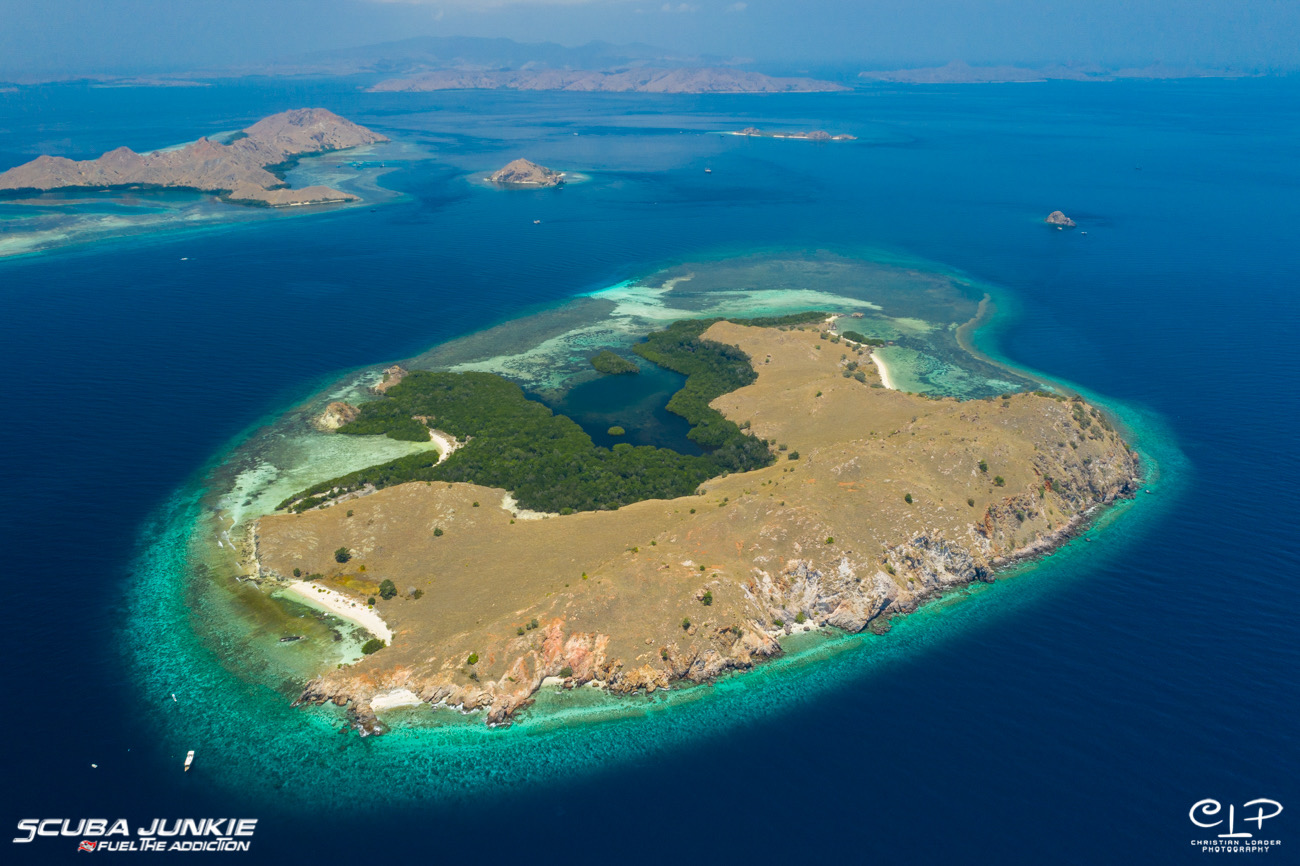
Komodo National Park (KNP) is one of the world’s treasure troves for marine biodiversity, including reef sharks.
In a survey across 11 dive sites (including Castle Rock, Crystal Rock, Karang Makassar (Manta Point), Batu Bolong, Tatawa Besar, Mawan), divers encountered 50 sharks over 35 dives. All sites had at least 1 shark per dive.
Shark encounters per dive ranged from 1 to 12 individuals depending on site
The most commonly observed shark species in Komodo include, Whitetip Reef Sharks, Blacktip Reef Sharks, Grey Reef Sharks, along with some Bamboo sharks.
These findings are just a snapshot of encounters in Komodo, but do offer insight into the fact that the shark population here is in a reasonably healthy state compare to other areas.
The increasing number of divers and tourism boats mean that there is more economic incentive to protect the sharks as the large number of divers visiting the area bring large inflows to cash to the region. But at the same time boat traffic, fishing pressure (legal/illegal) still cause massive risks. Management such as moorings, regulated dive quotas, and enforcement will be increasingly important as visitor numbers continue to increase in the area.
Due to the late sexual maturity and longer gestation periods even the loss of a small number of individuals can cause significant damage to the population as a whole. Without active protection numbers will continue to decline so our choices and impact as individuals is of the utmost importance.
Putting It Together: Implications for Scuba Divers in Komodo & Beyond
If you’re a diver concerned about reef sharks, here are some of the take‑aways, both encouraging and cautionary:
Encounters Are Still Good Despite global declines, Komodo remains one of the better places to see reef sharks. Multiple species are regularly encountered, including the bigger (relatively speaking) Grey Reef Sharks, especially at sites in the North of the Park like Castle Rock, Crystal Rock, Golden Passage and central sites such as Tatawa Kecil and Batu Bolong.
Juveniles & Nursery Habitats Matter Many reef sharks use shallow areas, lagoons, under ledges or table corals, or reef flats as nursery zones. In Komodo, pups are observed hiding under corals and can be found in the shallows of a number of islands. Divers who know these habitats and dive gently may be less disruptive, allowing these nursery functions to persist for long into the future.
Tourism Helps—but It Isn’t a Guarantee Well‑managed marine protected areas (with regulations, patrols, and limits on damaging human activity) tend to have healthier populations. Komodo is protected, and this offers some hope. But there are pressures: fishing, bycatch, pup harvest, pollution, and reef degradation.
Your Role as a Diver Can Make a Difference
Support operators committed to conservation and protecting the area.
Choose operators that have strict codes of conduct in terms of diver behaviour.
Citizen science helps. Surveys (like the dive‑based ones in Komodo) are very useful for monitoring.
If current decline rates hold up, some reef shark populations may become functionally extinct in certain reefs – meaning they are so rare that their ecological role is greatly reduced or lost. Less sharks can lead to overpopulation of mid‑predators, changes in fish community structure, coral reef health issues. Sharks are apex or meso‑predators in reefs and help balance the system. To ensure Komodo (and reefs elsewhere) continue being places where divers can reliably see reef sharks, these are some essential conservation measures needed from government bodies:
Better regulation & enforcement of directed shark fishing and other activities that cause by-catch.
Stronger implementation of marine protected areas with strict no‑take zones, patrols, limiting or even eliminating destructive fishing techniques and so on.
Education of local communities and tourists. Tourism can offer income and bring enormous financial gains to an area, but the tourists will only continue to come if marine life is well protected, abundant and healthy.
Conclusion
Globally, reef sharks (well all sharks) are in decline, with many reefs no longer hosting them in meaningful numbers. Locally, in Komodo National Park, the situation is much better than many places — but the signs of pressure are evident.
For scuba divers, that means Komodo is still a very good place to see reef sharks. But these encounters are not guaranteed forever unless conservation efforts keeps pace. Diving with awareness, supporting sustainable tourism and conservation policies, and spreading the word all help to ensure that future divers (and marine life) will still get to enjoy these iconic sharks.
Our colleagues over at Scuba Junkie Penida have also written an awesome and highly informative piece on the Species of Sharks In Nusa Penida which are quite different to what he can see here in Komodo. If you are interested in finding out more about our Special Combo Options for both locations then contact us now.
If you have enjoyed this blog and would would like to learn a little more about these magnificent creatures then check out Shark Guardian’s 100 Facts about Sharks!!
about us
We provide daily dive trips and dive courses around the Komodo National Park.
Looking for tips and tricks about diving, marine life or what to do in Indonesia? Follow us on our blog for weekly updates from the team!